# Butcher Counter Loyalty: Spend-Tier Incentives for High-Ticket Baskets
## Table of Contents
1. [The Core Answer](#the-core-answer)
2. [The Problem: Counter Speed Versus Basket Size](#the-problem-counter-speed-versus-basket-size)
3. [The Solution: Spend Tiers Built Around Butcher Basket Economics](#the-solution-spend-tiers-built-around-butcher-basket-economics)
– [Designing Tier Thresholds on Real Cut Margins](#designing-tier-thresholds-on-real-cut-margins)
– [The Counter Tablet Workflow at the Scale and the Till](#the-counter-tablet-workflow-at-the-scale-and-the-till)
– [Wallet Passes That Carry Tier Status](#wallet-passes-that-carry-tier-status)
– [Keeping Tier Status Consistent Across Branches](#keeping-tier-status-consistent-across-branches)
– [Triggering the Next Bulk Order Before the Freezer Empties](#triggering-the-next-bulk-order-before-the-freezer-empties)
4. [Implementation Checklist and Counter Protocol](#implementation-checklist-and-counter-protocol)
5. [Conclusion and Next Step](#conclusion-and-next-step)
> **The Core Answer:** Run three spend tiers on a rolling 60-day window, measure net spend at the POS, and pay rewards as counter credit plus bulk-order privileges. A tablet at the scale reads tier status in under two seconds, a phone wallet pass carries that status between visits, and automated prompts fire when a household’s buying rhythm signals a freezer restock. The outcome is a higher average ticket, shorter gaps between visits, and a bulk-order pipeline the owner can forecast.
## The Problem: Counter Speed Versus Basket Size
A butcher counter moves in 90-second increments. Weigh the chuck, wrap the chops, tap the card, bag it, next customer. The household spending $340 on a holiday standing rib roast waits in the same line as the one buying two chicken breasts, and the counter has no fast way to tell them apart. The record that matters — who buys bulk, how often, and how close they sit to their next big order — lives on a paper ticket or nowhere at all. Fixing that requires [retail POS loyalty and counter terminal integration](https://loyaltynation.io/platform/pos-integrations) that reads the sale as it happens instead of a separate system staff update later.
Plastic punch cards fail this workflow on three fronts. Staff forget to punch during a rush, cards get left in car consoles, and every punch counts a visit rather than a dollar amount, so a $22 weekly stop earns the same reward as a $400 bulk box. The owner ends the quarter with a stack of cards and no usable answer to a simple question: how many customers crossed $250 in spend during the last 60 days, and how many of them came back within three weeks?
That question drives the whole economics of a butcher shop. Bulk meat orders are the most plan-able revenue a counter has. A household buying a 20 lb mixed box or a quarter share of beef decides weeks ahead, clears freezer space, and often recruits a neighbor to split the order. Without a tier record, the shop cannot see who sits close to that decision, cannot prompt it, and cannot reward the person who brings it in.
The pain shows up in labor as well as revenue. Cashiers re-key phone numbers into a separate loyalty app, managers reconcile paper tickets at close, and nobody can compare a bulk buyer’s gross profit against a walk-in’s because the two baskets are never tagged. A tier system attached to the POS closes that gap with data the counter already produces.
## The Solution: Spend Tiers Built Around Butcher Basket Economics
Spend tiers convert the sale you already rang into a measurable position for each customer. The counter sees a name, a tier, and a distance-to-next-tier number. The customer sees progress on a phone wallet pass. The owner sees which tier drives which share of revenue.
### Designing Tier Thresholds on Real Cut Margins
Set tiers from margin math. Ground beef and chicken thighs carry thinner percentage margins than dry-aged steaks, so size the reward rate for the whole basket with a ceiling in place. A workable structure for a single-location shop:
| Tier | Rolling 60-day net spend | Reward | Operational privilege |
| — | — | — | — |
| Counter Regular | $200 | 3% back in counter credit | Skip-line pre-order pickup |
| Freezer Filler | $550 | 5% back in counter credit | Free vacuum sealing on orders over 8 lb |
| Bulk Buyer | $1,100 | 8% back in counter credit | 48-hour priority on holiday pre-orders and free local delivery |
Check the unit economics before publishing a table. A $600 bulk box at 28% gross margin returns $168 in gross profit. An 8% credit costs $48 and leaves $120, before counting the labor saved by one scheduled pickup instead of six small counter visits. Measure net spend after discounts, exclude gift cards and deposits, and count custom-cut weights entered at the scale so a special order is credited to the right profile.
### The Counter Tablet Workflow at the Scale and the Till
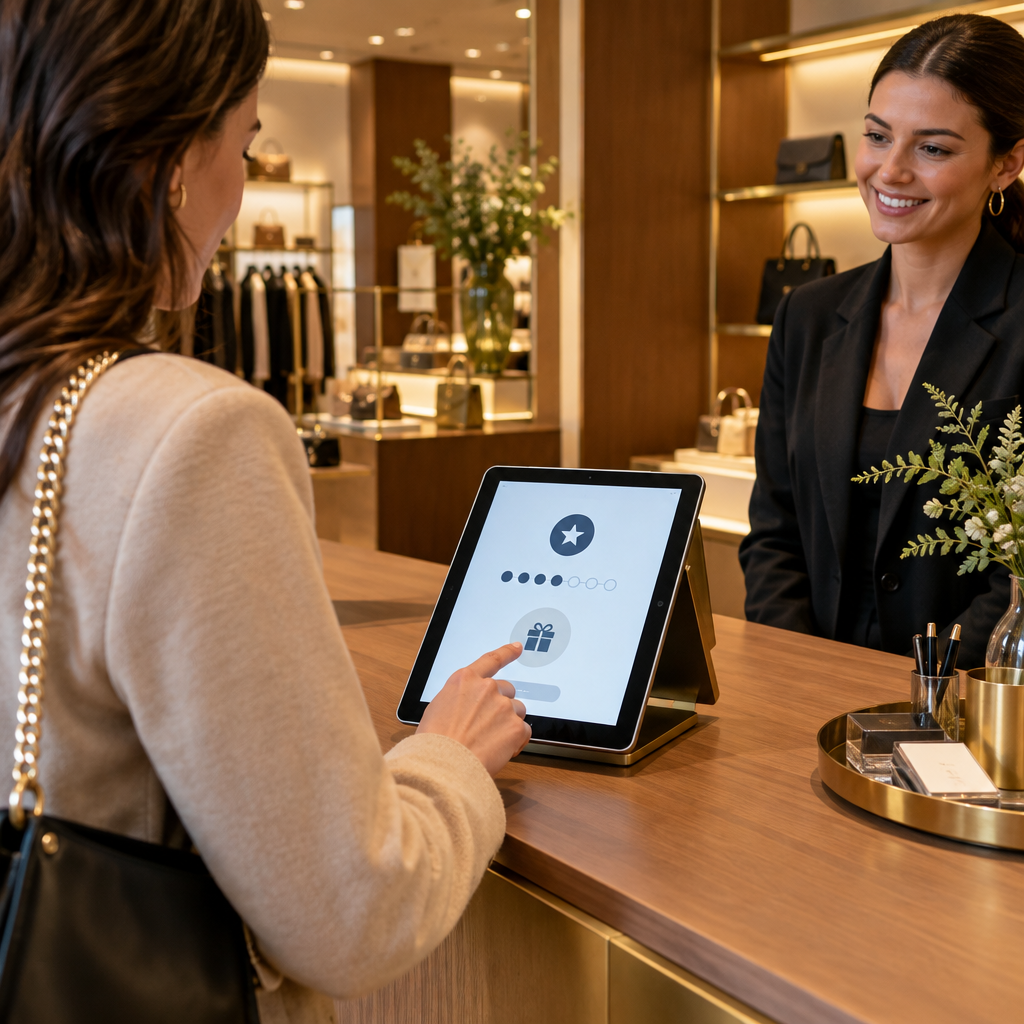
The tablet sits where the customer can see it, angled at the register. The cashier asks for a phone number or the customer taps a phone against the reader. The screen returns four things within two seconds: name, current tier, credit balance, and the dollar amount remaining to the next tier.
Staff behavior changes with clear prompts. When a Freezer Filler sits $40 from Bulk Buyer status, the tablet displays that gap. A cashier can say, add two more pounds of sausage and you lock in priority holiday ordering for the year. The prompt arrives at the moment of decision, which is the only moment that counts at a counter.
Configure the terminal for real counter conditions. Split payments across two cards should write spend once to one profile. A manager override should cover the customer who forgot their phone. The tablet should queue transactions locally when the connection drops and sync when it returns, so a Saturday rush never blocks tier accrual.
### Wallet Passes That Carry Tier Status
A phone wallet pass replaces the plastic card and travels with the customer. Apple Wallet and Google Wallet passes update by push notification when a tier changes or credit is issued, so the pass always shows current status instead of the balance from signup day. Print a QR code on the counter card and the receipt footer; the customer scans once and the pass installs in a few taps.
Wallet passes give the shop a delivery channel it controls. Update the pass back fields with the next threshold, the current credit, and the cut of the month. Set location-based display so the pass surfaces on the lock screen within a short walk of the shop. Shops running Square or Clover terminals can push tier updates from the POS in real time, which is covered in [Square & Clover Loyalty Sync: Real-Time Counter Data Across Stores](https://loyaltynation.io/resources/square-clover-pos-loyalty-integration).
### Keeping Tier Status Consistent Across Branches
A customer who buys a bulk box at the north location and ground beef at the south location holds one tier position. Run tier math against the chain-wide profile, then report performance by branch so each manager sees local contribution without fragmenting the customer record. Transfers and inter-branch pickups should count once. The configuration detail that matters most is a single customer ID across locations, described in [Multi-Store Loyalty Management: Unifying Customer Profiles Across Branches](https://loyaltynation.io/resources/multi-store-franchise-retail-loyalty-software).
Branch managers benefit from a tier view at the counter. When a Bulk Buyer walks into a location they rarely visit, the tablet flags the status and the cashier can thank them by name. That small recognition keeps a high-value household attached to the brand instead of to one storefront.
### Triggering the Next Bulk Order Before the Freezer Empties
Visit-gap automation turns tier data into a forecast. Most households follow a repeatable interval: a Freezer Filler might return every 24 days. When day 20 arrives without a purchase, the wallet pass updates with a pre-order prompt and the customer reserves a box for Saturday pickup.
Layer the calendar on top. Easter, Thanksgiving, Christmas, and the start of grilling season drive predictable bulk demand. Trigger Bulk Buyer outreach 10 to 14 days before each peak with a pre-order link, a deposit amount, and a pickup window. Track deposit conversion as a tier metric so the owner knows which tier commits cash before the holiday week.
## Implementation Checklist and Counter Protocol
| Step | Configure | Signal it works |
| — | — | — |
| 1. Baseline | Pull 90 days of average ticket, visit frequency, and share of baskets over $150 from the POS | Owner has a single baseline sheet |
| 2. Tier math | Set thresholds and reward rates against gross margin by category | Reward cost stays under 25% of tier gross profit |
| 3. Enrollment | Place the tablet at the counter, print QR codes on receipts | 40% of qualifying baskets enrolled in 30 days |
| 4. Cashier script | Train one line: name, tier, gap to next tier | Script used on every basket over $100 |
| 5. Pass delivery | Turn on wallet pass updates and location display | Pass open rate above 20% per month |
| 6. Visit-gap trigger | Automate the day-20 prompt for each tier interval | Pre-order reservations from triggered customers |
| 7. Branch reporting | Share tier revenue by location each week | Managers review tier mix in the weekly huddle |
Roll the program out in one tier first when the counter team is small. A single $250 threshold with 3% back and a pre-order skip-line privilege proves the concept in four to six weeks, and it gives the owner clean numbers before adding complexity.
## Conclusion and Next Step
Spend tiers work at a butcher counter because they attach to the transaction the cashier already completes. The tablet reads status in two seconds, the wallet pass carries it home, and the visit-gap trigger converts a household’s buying rhythm into a scheduled bulk order. Owners gain a revenue line they can forecast instead of a drawer of forgotten cards.
Book an in-store counter demo to see the tablet flow at the register, or calculate repeat foot traffic revenue gains against your own average ticket and visit frequency. Bring last quarter’s POS export and the team will model tier thresholds on your actual cut margins.